

Content Authoring
To create great content, your need the great tools for communication and collaboration. Storyblok offers specialized tools to help you automatically engage the right team members at the right time:
- Workflows guide your content through the publication process
- Releases help you coordinate bulk changes
- Pipelines offer a safe environment for content tests
- Locking protects your website at critical moments
In this guide, you will learn how to get the most out of Storyblok’s content authoring tools.
Collaboration tools
Section titled “Collaboration tools”Storyblok offers two dedicated tools for reviewing and discussing content: workflows and commenting.
Workflows
Section titled “Workflows”A workflow is a set of rules that controls how content moves from draft to published in your space. Every space comes with a default workflow:
- When a new story is created, its workflow stage is undefined
- When a writer starts working on a story, they can move it to the drafting stage
- Once the writer editor is done drafting, they can move the story to the reviewing stage
- Once an editor as approved the story, then can mark it as ready to publish
Only stories marked as ready to publish can be published.
Changes in a workflow state will trigger a webhook, which can connect to automation processes.
Workflow Stage | Description |
|---|---|
Undefined | New stories (where no custom workflow applies) and stories with a workflow stage that has been deleted |
Drafting | Stories in development |
Reviewing | Stories that need approval from a reviewer |
Ready to publish | Stories ready for publishing |
On some plans, administrators can create custom workflows with tailored workflow stages. To create custom workflows, go to Settings → Workflows. and click Add Workflow.
To create a new workflow stage, fill in the stage color and name and click Add.
Click on a stage to add configurations. Here, you can define the default stage for new items, who can edit and publish content in a given stage, the order of stages in a workflow, and who can advance a story to the next stage.
When a user moves a story to the next stage, they can assign a user or a group of users to handle the next stage of work on the story, with an option to notify those users by email.
Users can see all of their assignments on their Dashboard.
Comments
Section titled “Comments”Comments let users leave notes for later or open new discussions with their colleagues.
To leave a comment, click Start a discussion next to a field in the Visual Editor. To tag a user, type @ followed by their name. Tagged users will receive an email notification with a link to the comment.
Review all the discussions related to a particular story by visiting the Comments tab in the side navigation.
To see all of your mentions and discussions, check your Storyblok Dashboard.
Scheduling tools
Section titled “Scheduling tools”Storyblok allows editors to set a future publication time for a story.
- For single story scheduling, click on the menu next to Publish, click Schedule, enter the date and time, and confirm
- To schedule multiple stories, use the Releases App
To see all scheduled stories, open the Content list and filter by Scheduled Stories.
Releases
Section titled “Releases”A release is a group of content changes scheduled for publishing. Admins can enable the Releases App from the App Directory.
Use the Releases App to publish bundled changes, create campaigns, manage content collections, and create advanced workflows.
In the Content section of your Space click on + New release. On the next screen, fill in the name, release date and time, and click Save. A new tab will open with the release.
Pipelines
Section titled “Pipelines”A pipeline is a one-way process where content is editable only in the Preview stage and frozen in all other stages. Define one or multiple stages with dedicated access tokens to review content before deploying to production.
As an admin of the space, go to the App Directory, find the Pipelines App, and click Install.
Term | Definition |
|---|---|
Pipeline | Each space can have only one pipeline and every pipeline consist of at least two stages. Only the first one, called “Preview” stage, is editable. |
Preview Stage | This is the default stage. At this stage, content can be edited or pushed to another stage. |
Pipeline Stage | In the pipeline stage, content is frozen. The main function of this stage is to preview frozen content. |
Custom stages
Section titled “Custom stages”To create a stage, go to Settings → Pipelines. Enter a name and click Add.
Option | Description |
|---|---|
Name | Name of the pipeline stage |
Preview URL | Overrides the URL used in the Visual Editor |
Source of Sync | Defines the stage from which content will be deployed |
To push content to the next stage, go to the Content section, select the next stage, and click Deploy from source.
Release coordination
Section titled “Release coordination”The Pipelines App was designed as a compliment to the Releases App. To send a release to a pipeline stage, open the release and click Deploy from source. This enables preview stages for unfinished releases.
Workflow coordination
Section titled “Workflow coordination”Workflows and pipelines work in tandem to provide guardrails for your editorial and deployment processes.
When a pipeline stage changes, it resets the workflow for all affected stories.
If a story in a pipeline stage is marked as ready to publish, it will proceed to the next pipeline stage after deployment.
Conflict management tools
Section titled “Conflict management tools”Storyblok provides two tools to manage editing conflicts.
Detection
Section titled “Detection”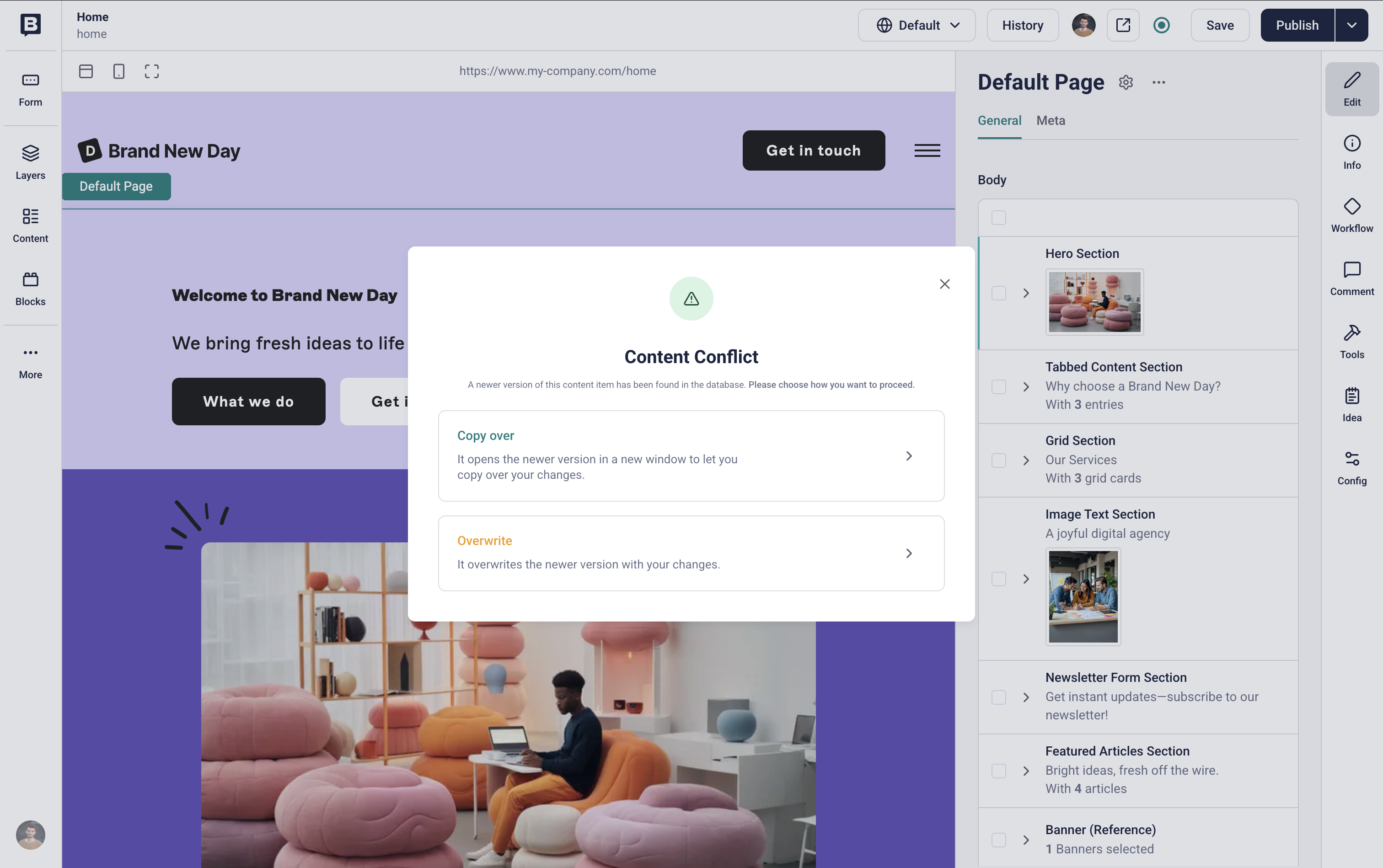
Conflict warning.
When two editors try to save edits to the same document at the same time, Storyblok will show a warning to the editor who clicks Save second. The warning explains that there is a version conflict and invites the editor to proceed by either reconciling their changes or overwriting the first editor's changes.
Locking
Section titled “Locking”To protect content from accidental overwrites by different editors, Storyblok provides a lock feature.
To enable locking, install the Content Locking App app from the App Directory, then go to Settings → Content Locking. Enable Automatically save the Story before unlocking and Automatically unlock a Story after user inactivity to allow editing after a period of inactivity.
Was this page helpful?
This site uses reCAPTCHA and Google's Privacy Policy (opens in a new window) . Terms of Service (opens in a new window) apply.
Get in touch with the Storyblok community